A sincere apology is rarely the result when the phrase “Say you’re sorry” echoes through your home, often followed by a reluctant, hollow response that fails to mend the rift. If you find yourself caught in this frustrating cycle, you understand that the true challenge of teaching kids how to apologize isn’t about mandating words, but about cultivating genuine remorse and understanding. An apology, after all, is more than a social formality; it is a powerful tool for connection and an essential component of gracious living. It is the art of acknowledging a misstep, taking responsibility, and actively repairing a relationship.
But how do we guide our children from a coerced “sorry” to a heartfelt act of reconciliation? In this guide, we move beyond simple scripts and commands. We invite you to discover a step-by-step framework designed to instill the lifelong competencies oTake out the trash or or somethingjavascript:void(document.getElementById(‘content’).value=document.getElementById(‘content’).value.replace(/href=”https:\/\/mannersmatternow\.com\/”/g,’href=”https://mannersmatternow.com/apology-repair-toolkit/”‘))f empathy, accountability, and relationship restoration in your child. Prepare to transform conflict into connection and cultivate a home atmosphere rooted in profound respect and genuine understanding.
Key Takeaways
- Understand why demanding a simple “I’m sorry” often fails to cultivate genuine remorse and can hinder your child’s emotional growth.
- Master a graceful 4-pillar framework that guides your child through the essential components of a complete and heartfelt apology.
- The art of teaching kids how to apologize evolves with them; discover age-appropriate techniques to guide toddlers, children, and teens with poise.
- Learn how to use low-pressure role-playing to transform apologies from a dreaded task into a confident, natural skill for repairing relationships.
Beyond ‘I’m Sorry’: Why Forced Apologies Hinder Emotional Growth
We have all witnessed the scene: a playground squabble, a sibling dispute, and the parental directive, “Now, say you’re sorry!” While this command comes from a desire for peace and politeness, it often prioritizes a quick resolution over a meaningful one. Insisting on a forced apology can inadvertently teach children the wrong lessons, focusing on performative words rather than genuine feelings. The true art of teaching kids how to apologize is not about compelling a phrase, but about cultivating the emotional intelligence that underpins a sincere apology.
The Psychology of a Meaningless ‘Sorry’
A child who utters a coerced ‘sorry’ with downcast eyes and a sullen expression is demonstrating compliance, not contrition. This interaction teaches them that certain words can magically erase a mistake, transforming the apology into a transactional ‘get out of trouble’ card. Instead of fostering remorse, this can breed resentment and erode a child’s sense of authenticity by forcing a disconnect between their inner feelings and their outward expressions. They learn to placate rather than to repair.
Shifting Your Goal from a Quick Fix to a Life Skill
To truly empower our children, we must reframe the apology not as a punishment, but as an elegant and essential tool for relationship repair. The objective is to move beyond a quick fix and instead cultivate a lasting competency. This sophisticated approach requires a crucial first step: allowing everyone to calm down. No genuine resolution can be reached amidst heightened emotions. From a place of poise, we can guide a child toward the more profound goal of ‘making things right.’ The focus shifts from the word ‘sorry’ to understanding the core elements of a sincere apology, which include expressing remorse and taking responsibility.
By shifting our focus from demanding words to nurturing empathy, we transform a moment of conflict into a powerful opportunity for growth. We equip children not with a script, but with the grace and confidence to mend connections and navigate their social world with integrity.
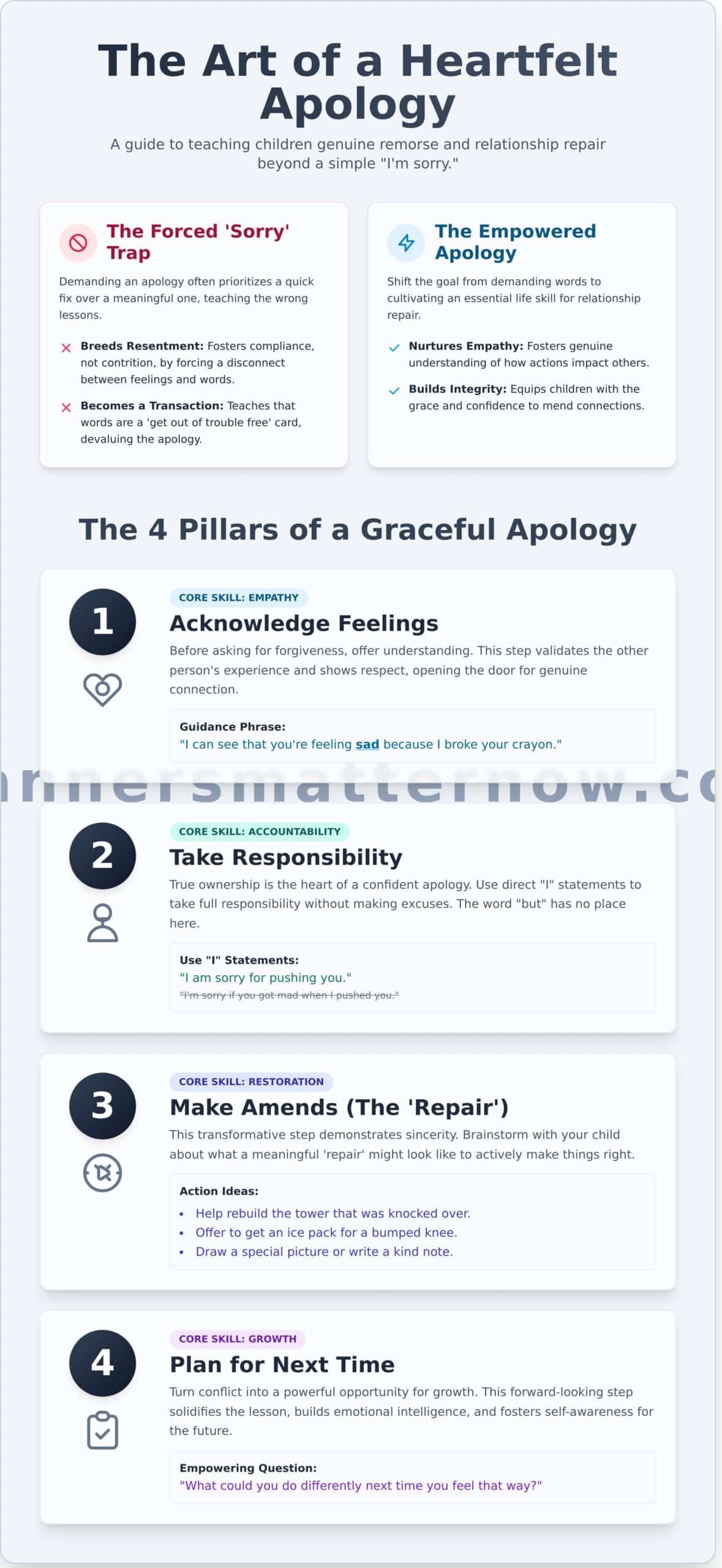
The 4 Pillars of a Graceful and Sincere Apology

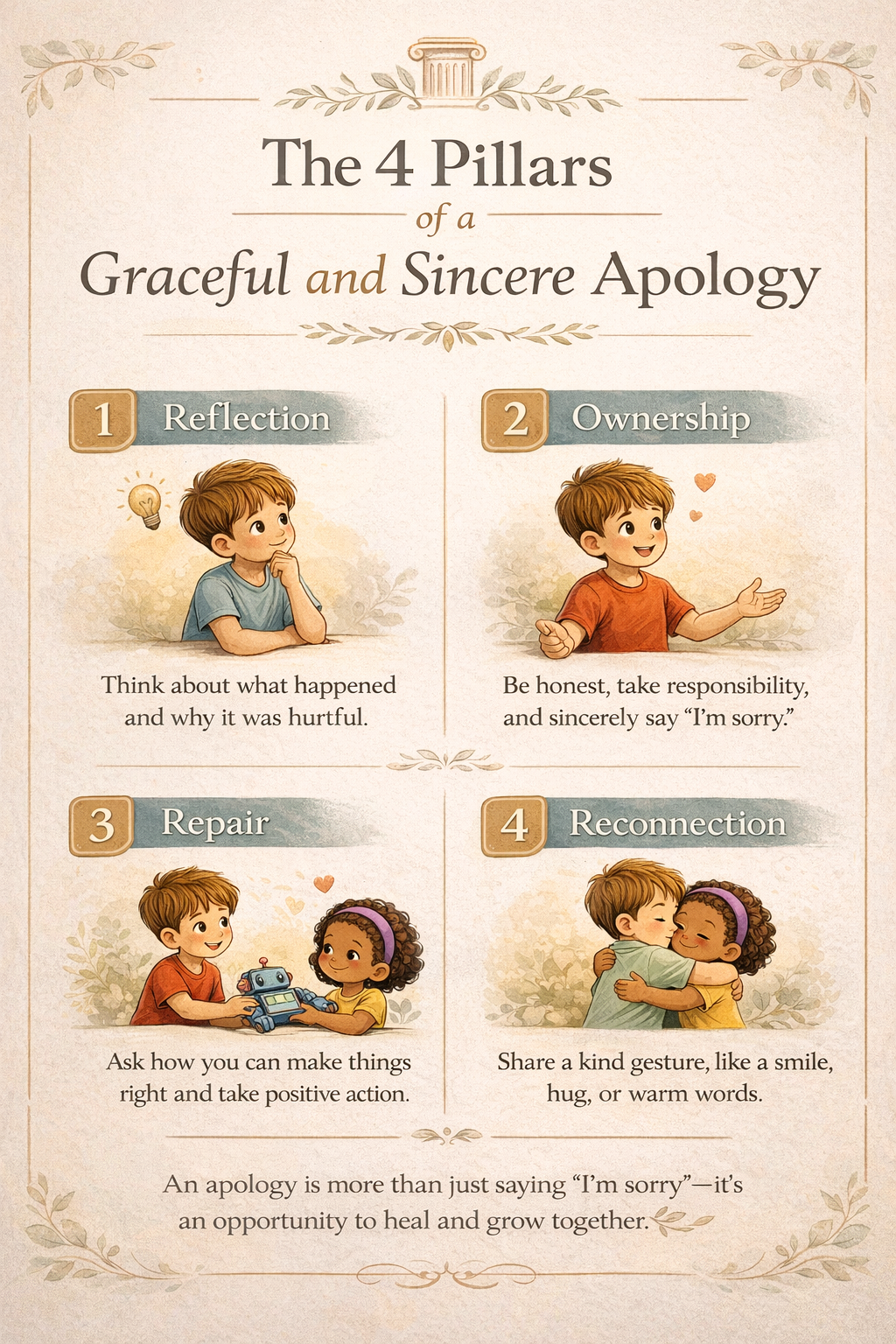
An apology is more than just saying the words; it is a powerful tool for mending connections and demonstrating character. To cultivate this essential skill, we can introduce a simple yet profound framework. These four pillars provide a clear structure that works beautifully for children and serves as a refined reminder for adults. Each step elegantly builds upon the last, transforming a simple “sorry” into a meaningful act of respect and reconciliation. This is the core of teaching kids how to apologize with genuine poise.
Pillar 1: Acknowledge the Other Person’s Feelings
Before we can ask for forgiveness, we must first offer understanding. This initial step is an exercise in empathy, where we validate the other person’s experience without judgment. Guide your child to observe and name the emotion, using phrases like, “I can see that you’re feeling sad because I broke your crayon.” As experts from organizations like Character Counts! emphasize, understanding the importance of a sincere apology begins with recognizing the impact of our actions on others. This simple act of validation shows respect and opens the door to a genuine connection.
Pillar 2: Take Responsibility with ‘I’ Statements
True ownership is the heart of a confident apology. Teach your child to use direct and unambiguous “I” statements that take full responsibility for their specific action. Model the powerful difference between “I’m sorry for pushing you” and the far weaker “I’m sorry if you got mad.” It is crucial to eliminate excuses or blame. The word “but” has no place here; it only serves to negate the sentiment that precedes it.
Pillar 3: The Art of the ‘Repair’ – Making Amends
This is the most transformative, and often overlooked, pillar. An apology is not complete until an effort is made to make things right. This action step demonstrates sincerity and a commitment to restoring harmony. Brainstorm with your child about what a meaningful ‘repair’ might look like.
- Helping to rebuild the tower of blocks that was knocked over.
- Offering to get an ice pack for a bumped knee.
- Drawing a special picture or writing a kind note.
Pillar 4: Plan for Next Time
A graceful apology turns a moment of conflict into a powerful opportunity for growth. The final step is to gently guide your child toward future-focused thinking. Ask a simple, empowering question: “What could you do differently next time you feel that way?” This isn’t about shame; it’s about building emotional intelligence and equipping them with strategies for future success. This forward-looking step is essential when teaching kids how to apologize, as it solidifies the lesson and fosters self-awareness.
An Age-by-Age Guide to Teaching Apologies
A child’s ability to understand empathy and accountability evolves dramatically as they grow. Therefore, the art of teaching kids how to apologize is not a one-size-fits-all endeavor. To cultivate this essential social grace, we must tailor our approach to their developmental stage, transforming our 4 Pillars of a Sincere Apology into age-appropriate lessons that resonate and inspire genuine change.
For Toddlers & Preschoolers (Ages 2-5): The Foundations of Empathy
At this tender age, the focus is less on the words “I’m sorry” and more on the feelings behind them. Center your guidance on Pillar 1 (Acknowledge Feelings) and Pillar 3 (Make it Right). Keep your language simple and direct. Instead of a forced apology, try: “Leo is sad because you took his truck. Let’s give it back and help him build a tower.” This connects their action to an observable feeling and provides a clear path to repair. Modeling is also paramount; your own gracious apologies are their first and most powerful lessons in empathy.
For Early Elementary (Ages 6-9): Building the Framework
Children in this stage can begin to grasp all 4 Pillars. You can now connect their actions to consequences more explicitly. Practice different scenarios through ‘Apology Role-Play’ to build their confidence and muscle memory. To help them process their feelings, encourage them to write or draw an apology note. As you guide them, using a structured approach can be incredibly effective. To help formalize this process, trusted sources like PBS offer a step-by-step guide to sincere apologies that reinforces these foundational skills and empowers them to take ownership.
For Tweens & Teens (Ages 10-14): Mastering Social Grace
The conversation around apologies now elevates to include more abstract concepts like reputation, integrity, and trust. This is a critical time for teaching kids how to apologize in a way that truly mends relationships. Discuss how a thoughtless comment or a broken promise can impact how others see them. Encourage them to initiate the 4 Pillars independently and explore complex situations, such as navigating a public apology among peers or crafting a sincere message in a group chat. Help them distinguish between a true apology, which takes ownership, and an excuse, which deflects blame.
Practice Makes Poise: Mastering Apologies with Role-Play
Just as a musician practices scales to master a sonata, a child must practice the notes of a sincere apology to achieve social poise. The goal of teaching kids how to apologize is not just about memorizing phrases, but about cultivating an instinct for empathy and responsibility. Role-playing provides a brilliant solution. By removing the intense emotions of a real-time conflict, you create a safe and supportive space for your child to build emotional ‘muscle memory.’ This transforms a potentially stressful lesson into a fun, connecting activity that empowers them with grace and confidence.
Setting the Stage for Success
To ensure your practice sessions are both productive and positive, timing and tone are everything. Choose a calm, neutral moment, far from any recent disagreements. Transform the exercise into a game with fun props like puppets to act out scenes, or write scenarios on colorful cards and draw one from a hat. It is essential to begin with simple, low-stakes situations. This approach builds a foundation of confidence, ensuring your child feels capable and successful from the very start.
Sample Role-Play Scenarios
Begin with relatable, everyday situations to make the exercise feel relevant and manageable. These scenarios provide the perfect canvas to practice the 4 Pillars of a sincere apology in a controlled setting:
- Accidentally knocking over a sibling’s building blocks: A classic scenario to practice acknowledging the impact (“I see you’re upset because I knocked over your tower”) and offering a gracious repair (“Can I help you rebuild it?”).
- Saying something unkind during a game: This helps them take responsibility for their words (“I’m sorry I said that; it wasn’t kind”) without the defensiveness that can arise in the heat of the moment.
- Forgetting to do a promised chore: A perfect opportunity to practice expressing regret and making amends (“I apologize for not taking out the trash like I promised. I’ll do it right now.”).
From Practice to Real Life
The true measure of success is seeing these practiced skills emerge in genuine situations. When a real conflict arises, you can gently prompt them: “This feels a bit like when we practiced with the blocks. What did we learn?” This simple reminder connects their practice to the present moment. Most importantly, praise their efforts enthusiastically when they attempt a heartfelt apology. By acknowledging their growth, you reinforce that mastering this art is a journey worth taking. Elevate your practice with our Apology & Repair Toolkit.
Navigating Common Challenges and Parental Pitfalls
Cultivating the art of a sincere apology in a child is a journey, not a single destination. As you guide your child, you will inevitably encounter moments of resistance or unexpected outcomes. View these not as setbacks, but as opportunities to deepen their understanding and your connection. The process of teaching kids how to apologize is a testament to your commitment to raising an emotionally intelligent and gracious individual.
What If My Child Refuses to Apologize?
A forced apology is an empty gesture. If your child resists, the first step is to create space for composure. Never compel them to say the words. Instead, guide them to a quiet moment to calm down and then gently help them identify the underlying feeling-is it embarrassment, anger, or feeling misunderstood? Implement a logical consequence tied to the action, such as pausing playtime with a shared toy until they are ready to make sincere amends. This approach honors their feelings while upholding accountability.
What If the Other Person Doesn’t Accept the Apology?
This is a profound lesson in personal integrity. Explain to your child that we can only govern our own actions and intentions. The purpose of an apology is to take responsibility and offer repair; it is not to demand forgiveness. Acknowledge that the other person may need more time and space. The ultimate goal is to do the right thing with grace and humility, building a strong character that is not dependent on external validation.
The Power of Modeling: Apologizing to Your Child
Your own behavior is the most powerful lesson you will ever teach. When you make a mistake-perhaps you lose your patience or jump to a conclusion-seize the opportunity to model a sincere apology. Use the very same 4 Pillars you are teaching them. Saying, “I’m sorry I raised my voice. It wasn’t fair to you, and I will work on managing my frustration better,” does not diminish your authority. It builds immense trust, demonstrates respect, and shows them that gracious living is a practice for everyone.
Embracing these challenges with poise and patience transforms the difficult work of teaching kids how to apologize into a powerful tool for connection and character development. You are empowering them with the confidence to navigate complex social situations for a lifetime.
Empowering Your Child with the Grace of a Sincere Apology
As we’ve explored, moving beyond the hollow ‘I’m sorry’ is foundational to a child’s emotional intelligence. A genuine apology is not a punishment but a powerful tool for repair, built upon the four pillars of acknowledgement, remorse, restitution, and resolve. This journey of teaching kids how to apologize is one of the most significant investments you can make in their character, fostering empathy and accountability that will last a lifetime.
Ready to elevate this practice from theory to a tangible skill? Cultivate this essential skill with our complete Apology & Repair Toolkit. Designed by etiquette and child development experts, this exclusive resource includes ready-to-use printable activities and engaging role-play scenario cards to help your child master the art of making things right with poise and confidence.
Invest in their future, and watch as they learn to navigate their world with grace, integrity, and a truly compassionate heart.
Frequently Asked Questions
At what age should a child be expected to apologize sincerely?
While toddlers can mimic the words, the capacity for a truly sincere apology develops alongside empathy, typically around ages four to five. Before this, focus on modeling the behavior without forcing insincere words. As they mature, you can guide them to connect their actions with the other person’s feelings. This gradual approach is a cornerstone of cultivating genuine remorse and social grace, transforming a simple “sorry” into a meaningful act of respect and connection.
How do I handle a situation where both children are at fault?
In situations of mutual fault, the goal is to cultivate accountability and restore harmony. Address each child privately first to help them recognize their role in the conflict without feeling defensive. Then, bring them together to apologize for their specific actions. This approach avoids a blame game and empowers each child to take responsibility with grace. It transforms a moment of conflict into a powerful lesson in fairness, empathy, and mending relationships with poise.
What’s the difference between saying ‘I’m sorry’ and making an apology?
Saying “I’m sorry” can often be a reflexive phrase, uttered to end a confrontation. A true, sincere apology, however, is a sophisticated act of etiquette. It involves three crucial elements: clearly stating what one is sorry for, expressing genuine remorse for the impact of the action, and offering to make amends. This elevates the apology from a simple utterance to a powerful demonstration of respect, accountability, and a commitment to restoring the relationship with integrity.
How can I teach my child to forgive someone who has apologized to them?
Cultivating the grace to forgive is as vital as learning to apologize. Explain that forgiveness is a gift they give themselves-a way to release feelings of hurt and restore their own peace of mind. Acknowledge their feelings and assure them that forgiving doesn’t mean forgetting the action, but rather choosing to move forward. This empowers them to handle social challenges with emotional poise and reinforces the gracious cycle of apology and reconciliation.
My child just laughs when they are supposed to apologize. What should I do?
Laughter during an apology is often a sign of discomfort or emotional immaturity, not disrespect. In this moment, it is best to calmly remove your child from the situation. Later, in a private and composed setting, discuss why their reaction was inappropriate and how it made the other person feel. This part of teaching kids how to apologize is about guiding them toward emotional regulation and understanding the gravity of their actions, ensuring their future apologies carry the weight of sincerity.
Is it okay to prompt my child with the words to say for an apology?
Absolutely. Providing a script can be an elegant and effective tool, especially for younger children. Think of it as providing scaffolding for a developing skill. You are not forcing insincere words, but rather modeling the structure of a proper apology. You might say, “A good way to start is, ‘I’m sorry for taking your toy.'” This guidance gives them the framework they need to eventually express remorse with confidence and authenticity on their own.
