They said “sorry”… but it sounded flat, rushed, or forced. If you’ve ever watched your child mumble an apology while rolling their eyes, you know the worry that follows: Will they learn to take responsibility? Will they learn how to repair relationships
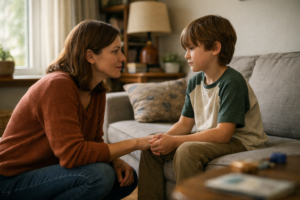
Here’s the good news: teaching kids to apologize sincerely is a skill, not a personality trait. Kids can learn it the old-school way—through clear expectations, calm practice, and lots of real-life coaching.
When children understand what a real apology does (it repairs, not just ends trouble), they grow in empathy, confidence, and self-control. And your home feels calmer because conflicts actually get resolved.
Quick Answer: Teaching kids to apologize sincerely works best when you focus on four parts: name what happened, name the impact, take responsibility, and offer to make it right. Keep it short, calm, and specific. Practice with role-play, model sincere apologies yourself, and avoid forced “say sorry” moments when emotions are still high.
Why “Just Say Sorry” Doesn’t Work
Many of us were raised with a simple rule: if you hurt someone, you say “sorry.” That rule isn’t wrong—but it’s incomplete. Teaching kids to apologize sincerely means helping them understand why they’re apologizing, not just what words to say.
When kids are forced to apologize while they’re still angry or embarrassed, the apology often becomes:
- A performance to avoid consequences
- A power struggle (“You can’t make me!”)
- A shutdown (“Fine. Sorry.”)
In those moments, “sorry” doesn’t repair anything. It can even make the hurt child feel worse, because the apology sounds fake.
What a sincere apology actually does
A sincere apology is a small act of courage. It says, “I see what I did, I care about how it affected you, and I’m willing to fix it.” Teaching kids to apologize sincerely is really about helping them rebuild trust.
When Kids Are Ready to Apologize (Timing Matters)
One of the biggest secrets to teaching kids to apologize sincerely is learning to wait for the right moment. If your child is flooded with big feelings, their brain is in defense mode. That’s not the time for a heartfelt apology.
Try this simple approach:
- Pause the conflict: Separate, breathe, get safe.
- Calm first: Water, a few minutes alone, a short reset.
- Then repair: Come back to talk and apologize.
Signs your child is ready
- Voice is calmer
- Body is relaxed (not clenched or storming)
- They can explain what happened in simple words
If they’re not ready, you can say: “We will fix this after you calm down. I’m here to help.”
The Old-School “Sincere Apology” Checklist (Simple and Clear)
Teaching kids to apologize sincerely goes more smoothly when you give them a clear structure. Old-school manners are not about fancy words—they’re about respect and responsibility.
Use this four-part checklist. It’s easy enough for grade-school kids but strong enough for teens.
| Part | What it sounds like | Why it matters |
|---|---|---|
| 1) Name what happened | “I grabbed your marker without asking.” | Shows honesty and clarity |
| 2) Name the impact | “That was rude and it upset you.” | Builds empathy |
| 3) Take responsibility | “It was my choice. I shouldn’t have done it.” | Stops excuses |
| 4) Make it right | “Can I replace it / help fix it / give it back?” | Repairs trust |
A simple script kids can memorize
Here’s a kid-friendly script that supports teaching kids to apologize sincerely without sounding stiff:
“I’m sorry for ______. That was ______. It made you feel ______. Next time I will ______. Can I do anything to make it right?”
Keep it short. A sincere apology doesn’t need a speech.
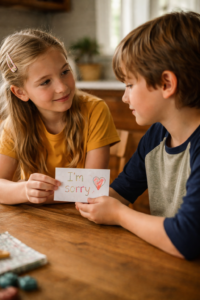
How to Teach It: Modeling, Coaching, and Practice
If you want to teach kids to apologize sincerely, stick to it like any life skill: you demonstrate it, you coach it, and you practice it.
1) Model sincere apologies at home
Kids learn more from what we do than what we say. When you mess up (we all do), try a calm, respectful apology:
“I snapped at you earlier. That wasn’t fair. You didn’t deserve that. I’m sorry. I’m going to take a breath next time.”
This shows that apologizing is not humiliating—it’s responsible.
2) Coach in the moment (without lecturing)
When a conflict happens, keep your voice steady and guide them through the steps:
- “Tell your brother what you did.”
- “Now say how it affected him.”
- “What can you do to make it right?”
Teaching kids to apologize sincerely works best when the coaching is brief and consistent.
3) Practice with role-play (yes, really)
Role-play feels silly, but it works because it gives kids words when they’re calm—so they can find those words later when they’re upset.
Try 5-minute practice once a week:
- “You bumped into a friend in line.”
- “You laughed when someone got the answer wrong.”
- “You forgot to do a chore and it affected the family.”
Then switch roles. Let your child “be the parent” and coach you.
Age-by-Age: What Sincere Apologies Look Like
Teaching kids to apologize sincerely should match their age and maturity. Here are realistic expectations.
Ages 4–6: Keep it concrete
- Short phrases: “I’m sorry I hit you.”
- Immediate repair: “Here’s your toy back.”
- Parent helps with words.
At this age, focus on naming the action and making it right.
Ages 7–10: Add empathy and responsibility
- “I shouldn’t have said that.”
- “I can see you felt embarrassed.”
- “Next time I’ll ask first.”
This is a sweet spot for teaching kids to apologize sincerely, as it helps them understand feelings and fairness.
Ages 11–14: Respect their dignity
- Give privacy when possible
- Encourage direct repair (texting counts, if done well)
- Focus on trust: “How will you rebuild it?”
Teens can smell fake apologies. Keep it real, not dramatic.
What to Say When Your Child Refuses to Apologize
Refusal is common, especially when a child feels ashamed. Teaching kids to apologize sincerely involves helping them navigate pride and fear.
Try these parent-friendly lines:
- Offer a reset: “You don’t have to do it this second. You do have to do it today.”
- Name the goal: “We’re not apologizing to get out of trouble. We’re apologizing to repair.”
- Give choices: “Would you rather say it out loud or write a note?”
- Stay firm: “In our family, we make things right.”
When “sorry” is used as a weapon
Some kids say “sorry” sarcastically to provoke. Treat tone as part of the lesson:
“Those words could be an apology, but that tone isn’t respectful. Let’s try again when you’re ready to mean it.”
Common Apology Mistakes (and How to Fix Them)
Teaching kids to apologize sincerely gets easier when you know what to avoid.
1) “I’m sorry you feel that way.”
This sounds like a dodge. Coach a better version:
Instead: “I’m sorry I said that. It was unkind.”
2) Adding excuses
“Sorry, but you started it” is not an apology. Teach responsibility first, explanations later.
Instead: “I was mad, but I still shouldn’t have pushed you.”
3) Over-apologizing
Some kids (especially sensitive ones) apologize for everything. Teaching kids to apologize sincerely also means teaching when an apology is not needed.
Try: “You made a mistake, and you fixed it. Now we move forward.”
Build a Family Culture of Repair (Not Shame)
The goal of teaching kids to apologize sincerely is not perfect behavior. The goal is a home where mistakes are handled with responsibility and respect.
Try these simple habits:
- Use “repair time”: After a calm-down, everyone does their part to fix the moment.
- Notice good apologies: “That was specific and kind. You owned it.”
- Celebrate making it right: Not with prizes, but with warmth: “Thank you for fixing that.”
A quick “repair routine” you can post on the fridge
- 1) Calm down
- 2) Say what happened
- 3) Say why it was wrong
- 4) Make it right
- 5) Move forward
This routine supports teaching kids to apologize sincerely by turning apologies into a normal family skill.
FAQ: Teaching Kids to Apologize Sincerely
Q: Should I make my child apologize even if they don’t mean it?
A: Don’t force a rushed apology in the heat of the moment. It requires repair. Wait for calm, then coach the steps. Teaching kids to apologize sincerely works best when the child understands the impact and has words to match it.
Q: What if the other child won’t accept the apology?
A: Teach your child that a sincere apology is their responsibility, not a guarantee. They can still offer to make it right and give space. Teaching kids to apologize sincerely involves teaching them patience and respect for the other person’s feelings.
Q: How do I handle sibling fights where both are wrong?
A: Coach each child separately: “What did you do that made it worse?” Then have each give their own apology. Avoid group apologies like “Both of you say sorry.” Teaching kids to apologize sincerely means each child takes ownership of their part.
Q: Is writing an apology note okay?
A: Yes, especially for shy kids or older kids who need time to think. A note should still include responsibility and repair. Teaching kids to apologize sincerely is about honesty and follow-through, not the format.
Final Thoughts (and a Simple Next Step)
Teaching kids to apologize sincerely isn’t about raising perfect children. It’s about raising children who can face their mistakes with courage, show respect, and repair relationships. That’s old-school manners at their best.
CTA: This week, choose one calm moment to practice the four-part apology checklist with your child. Print it, post it, and use it the next time conflict hits. You’ll be surprised how quickly “sorry” turns into real repair.
