If you’re wondering how can we show respect, the answer starts closer to home than you think. Respect isn’t only something we give—it’s also something we practice inside ourselves. When kids build self-respect (healthy boundaries, kind self-talk, safe choices), they’re more likely to treat others well, too. OK

If you’re asking **how can we show respect**, start with self-respect: care for your body, speak to yourself kindly, and set healthy boundaries. Kids who practice self-respect tend to use calmer words, accept “no” better, and repair mistakes more easily—because they feel safer and more confident.
Why This Matters
Kids who feel ashamed or powerless often try to regain control by being rude, bossy, or dismissive. Self-respect reduces that “control grab” and makes respectful behavior more natural. Think about it this way: a child who feels worthless on the inside has very few emotional resources to offer kindness on the outside. They may lash out, shut down, or bully others—not because they are bad kids, but because they haven’t learned to value themselves first. When we teach children to respect their own bodies, feelings, and choices, we give them a solid foundation for treating other people with care. That’s why the question of how can we show respect always leads back to the same starting point: self-respect.
What Self-Respect Looks Like (Kid-Friendly)
* “My body deserves safety.”
* “My feelings matter.”
* “I can make a better choice.”
* “I can say no politely.”
These simple statements may sound small, but they carry enormous weight in a child’s daily life. A child who believes their body deserves safety is less likely to tolerate bullying—and less likely to bully others. A child who says “I can make a better choice” is already practicing the kind of inner dialogue that leads to respectful behavior at school, at home, and on the playground. Self-respect gives kids an emotional anchor, and that anchor keeps them steady when peer pressure, frustration, or conflict shows up.
How Self-Respect Turns Into Respect for Others
So how exactly does self-respect translate into respectful behavior toward others? There are four key connections that parents and caregivers can watch for and encourage in everyday life.
1) Self-talk becomes people-talk
If kids learn “I can try again,” they’re less likely to say “You’re stupid” when frustrated. The way children speak to themselves becomes the blueprint for how they speak to others. A kid who practices saying “I made a mistake, but I can fix it” develops patience with others who make mistakes too. Over time, positive self-talk creates a habit of kindness that naturally extends outward.
2) Boundaries teach consent and space
Kids who practice “Please stop” also learn to hear “stop” from others. When a child learns to set boundaries for themselves—like saying “Please stop, I don’t like that”—they also begin to understand that other people have the same right. This two-way respect for personal space and consent is one of the most powerful social skills a child can develop early on.
3) Calm coping reduces conflict
When kids have tools to manage anger, they don’t need to resort to disrespect to vent. Teaching kids calm-down strategies—like deep breathing, counting to ten, or taking a short walk—gives them healthy ways to manage big emotions. Instead of yelling or hitting, they learn to pause and respond with words. This is a game-changer for sibling fights, classroom disagreements, and friendship conflicts alike.
4) Repair builds both kinds of respect
Owning mistakes strengthens self-respect and restores respect with others. When a child says, “I’m sorry, next time I’ll handle it differently,” they are doing two things at once: honoring their own ability to grow (self-respect) and showing the other person that the relationship matters (respect for others). Teaching kids to repair after a conflict—instead of hiding from it or pretending nothing happened—builds emotional resilience and trust in every relationship.
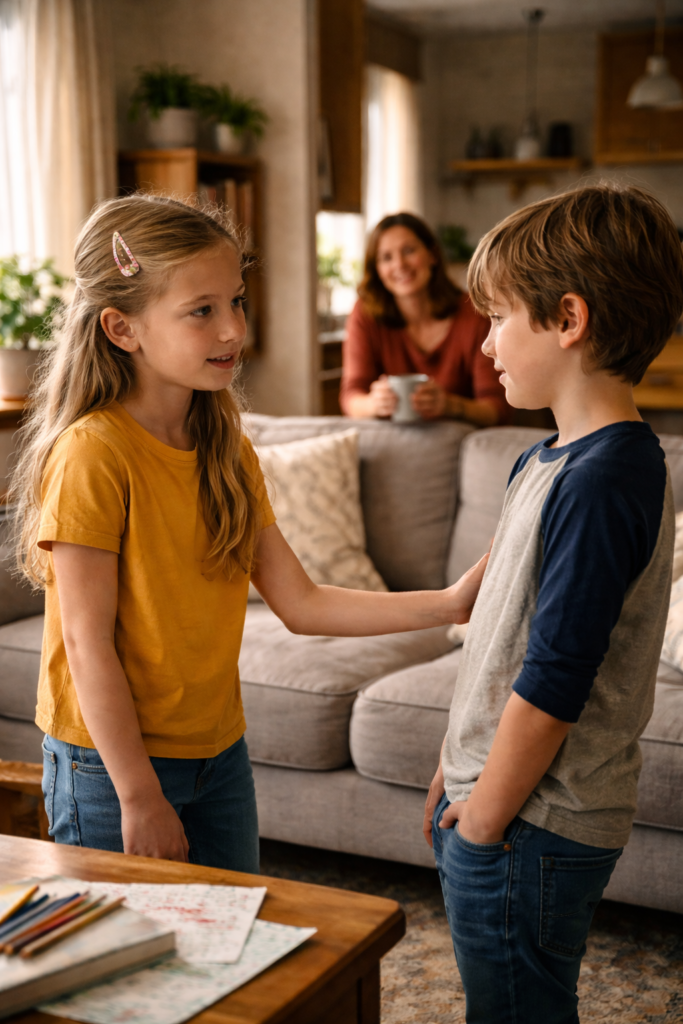
Step-by-Step: Teach Respect From the Inside Out
1. Pick one self-respect habit (sleep, food, calm-down plan, self-talk).
2. Connect it to others: “When you’re rested, you’re kinder.”
3. Teach one boundary script.
4. Practice one repair script.
5. Praise the connection: “You took space—then used kind words.”
You don’t have to tackle all five steps at once. Start with whichever one feels most relevant to your child right now and build from there. Even small, consistent efforts add up quickly. Within a few weeks, you may notice your child using kinder words, handling frustration more calmly, and showing more empathy toward siblings and friends.
Scripts (Simple + Powerful)
* Self-respect: “I need a break.”
* Respect for others: “Are you okay?”
* Boundaries: “Please stop. I don’t like that.”
* Repair: “I’m sorry. Next time I’ll __.”
These scripts work best when you practice them during calm moments—not in the middle of a meltdown. Try role-playing at dinner or before bed. The more familiar these phrases become, the more naturally your child will reach for them when emotions run high. You can even write them on index cards and tape them to your child’s mirror or inside their backpack as gentle reminders.
Common Myths
* Myth: respect = obedience → Real respect includes voice + boundaries.
* Myth: self-respect is selfish → It’s the foundation of safe behavior.
Many parents confuse respect with blind obedience, but true respect is a two-way street. A child who respects themselves knows they have a voice, and a child who respects others knows how to use that voice with kindness. Similarly, teaching kids to value themselves is not selfish—it is what makes them safe, confident, and capable of genuine empathy.
Quick Reference Table
| Skill | Self-respect example | Respect for others example |
| ———– | ——————– | ————————– |
| Boundaries | “I need space.” | “I’ll give you space.” |
| Self-talk | “I can try again.” | “Let’s try again.” |
| Repair | “I made a mistake.” | “How can I fix it?” |
| Calm coping | breathe, pause | speak kindly |
FAQ
**Q: How can we show respect when we disagree?**
A: Use calm tone + clear words: “I see it differently because…” You don’t have to agree with someone to treat them respectfully. Teach your child to listen first, then respond using a calm voice. Phrases like “I understand your point, but I think…” show that you can hold your own opinion while still valuing the other person’s perspective.
**Q: What if my child has low self-esteem?**
A: Start with tiny wins and kind self-talk swaps; confidence grows through repetition. Focus on one small habit at a time, like replacing “I can’t do anything right” with “I’m still learning.” Celebrate effort, not just results. Over time, these small shifts in language and attention build a stronger sense of self-worth that carries into every area of your child’s life.
The bottom line is this: if you want to raise respectful kids, start by helping them respect themselves. Self-respect is not a luxury or an extra—it is the engine that drives every act of kindness, every healthy boundary, and every sincere apology your child will ever make. The connection between how we treat ourselves and how we treat others is one of the most important lessons any family can teach. And it starts today, with one small habit at a time.
